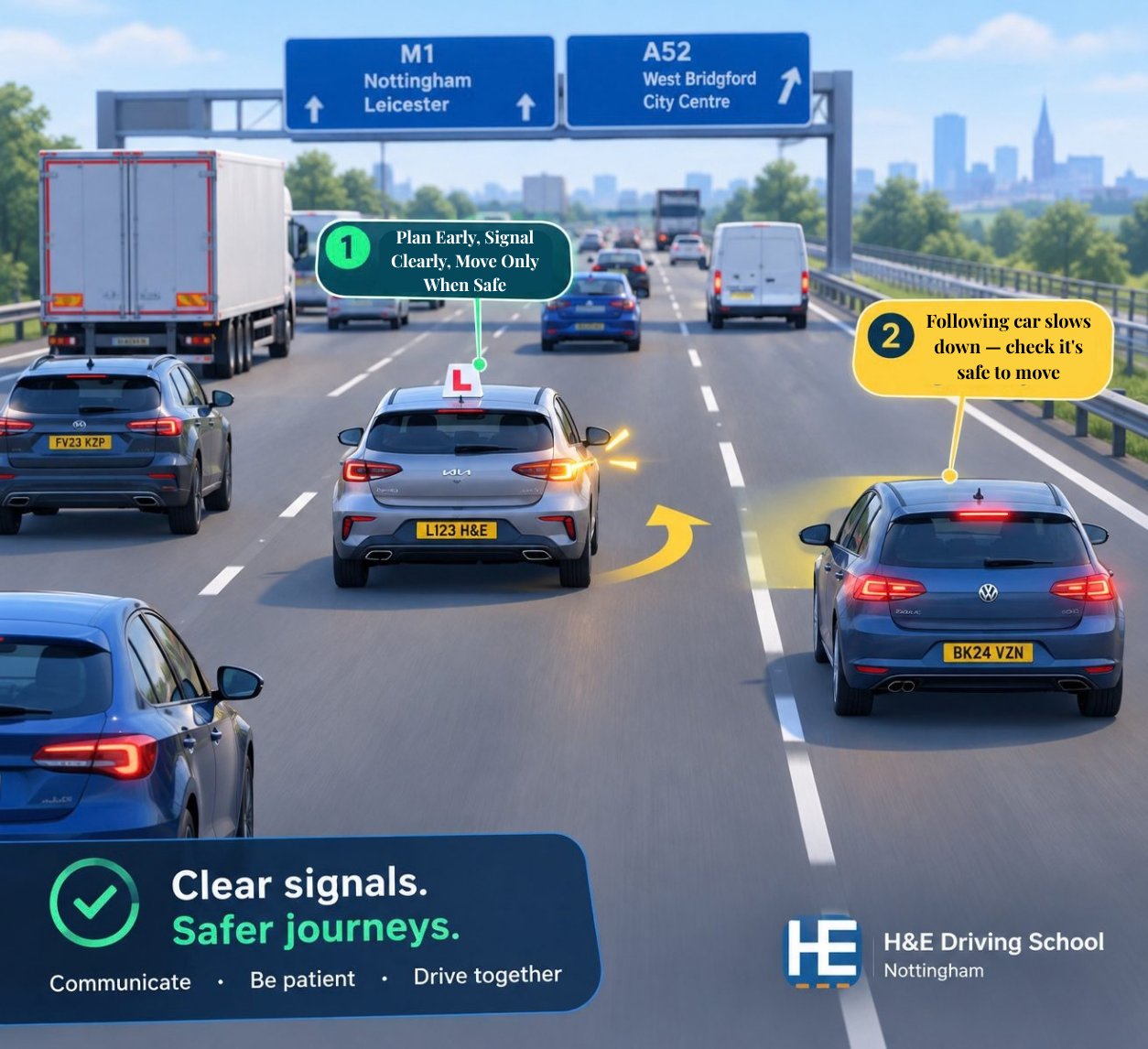
Key Takeaways
- Signal in good time — once you've checked it's safe and your signal won't mislead other road users, not just when you spot a gap
- A signal communicates your intention — it does not give you priority or guarantee another driver will make space
- Move only when the lane is clear — keep checking your mirrors and blind spot, and wait if a safe gap isn't there yet
- Look for a genuine, usable gap — a car slowing down can mean many things, not just "come in"
- Never assume a headlight flash means you have permission to move across
- In congested traffic you don't always need to change lanes immediately — follow signs and road markings, and merge in turn only at very low speed
The Golden Rule: Plan Early, Signal Appropriately, Move Only When Safe
A simple way to structure a lane change is:
- Plan — identify the lane you need in good time and check your mirrors well before you have to act
- Observe — assess the traffic around you, including the relevant blind spot if necessary
- Signal when appropriate — once you've checked it's safe and your signal won't mislead other road users, use your indicator to communicate your intention
- Reassess — keep checking your mirrors and blind spot as the situation develops; a gap can open, close, or turn out not to be genuine
- Move when clear — move over smoothly only when you're satisfied it is safe
A signal communicates your intention — it does not give you priority or guarantee that another driver will make space. It simply lets the traffic around you know what you'd like to do, so they have time to react if they're able to.
A Signal Is Communication, Not Permission
A signal tells others what you intend to do. It does not give you priority or create a gap.
Don't Wait Until the Last Second
Ask any learner why they don't signal until they've already spotted a gap, and you'll usually hear one of two things: "If I signal too early, won't the car behind just speed up and block me?" or "There's no space to move into yet, so what's the point of signalling now?"
Both feel logical in the moment, but waiting until the very last moment to signal and move into a gap can leave you with less time to properly assess the traffic around you. If your lane change causes another road user to change course or speed unexpectedly, the manoeuvre may be unsafe and could affect your driving-test result depending on the circumstances.
Planning your move early and signalling in good time isn't slower. It gives everyone around you fair warning and more time to react safely.
How to Read the Traffic
Once you've signalled, continue reading what's happening behind and beside you, and move only when you're satisfied it is safe:
- Look for a genuine, usable gap — if the vehicle in the lane you want slows down and opens up enough space, reassess the whole situation before moving. A driver slowing could mean traffic ahead, a junction, a pedestrian, a hazard, or simply a normal speed adjustment — not necessarily "come in"
- Treat a headlight flash with caution, never as permission — the Highway Code is clear that flashing headlights is only meant to let other road users know you are there, and should never convey any other message. Never assume that another driver's gesture, flash, or speed change means you have permission to move across
- Keep checking — continue using your mirrors and, just before moving across, check the relevant blind spot if necessary. A blind-spot check is only useful if you respond appropriately to what you see. Move over smoothly only when you're satisfied it is safe and clear
Never assume a headlight flash means another driver is inviting you to proceed. Use your own judgement and make sure the manoeuvre is safe.
What If There Is No Gap?
Don't force it. If the gap isn't there, stay in your lane and continue looking for another safe opportunity — you may need to wait longer than expected in heavy traffic, and that's fine. A signal does not give you priority, and another driver is not required to make space for you.
"If you need to change lane, first use your mirrors and if necessary take a quick sideways glance to make sure you will not force another road user to change course or speed. When it is safe to do so, signal to indicate your intentions to other road users and when clear, move over."
Heavy Traffic & Merging Lanes
When traffic is heavily congested, you do not always need to change lanes immediately. Follow the signs and road markings and avoid unnecessary lane changes.
Where lanes are merging and traffic is moving at very low speed, merging in turn can be appropriate when it is safe and suitable — each lane takes turns to move forward. The Highway Code does not recommend merging in turn at higher speeds.
Rule 134 says to follow signs and road markings and get into the correct lane as directed. In congested conditions, you should not change lanes unnecessarily. Merging in turn is recommended only when it is safe and appropriate and traffic is moving at very low speed, such as in queues.
On busy roads like the A52 and Nottingham's Ring Road, this kind of patient, well-planned approach is what keeps lane changes calm and predictable, even when traffic is nose-to-tail.
Highway Code References
- Rule 103 — give clear signals in plenty of time, having checked it is not misleading to signal at that time
- Rules 110–111 — headlight flashes are only to let others know you're there, never an instruction to proceed
- Rule 133 — check your mirrors and, if necessary, the blind spot; signal when safe and move over when clear
- Rule 134 — follow signs and markings in congested traffic; merge in turn only at very low speed
- Rule 161 — use your mirrors frequently, and remember they don't cover every blind spot
Read the full wording of these rules on the official GOV.UK Highway Code: Rules 103–158 and Rules 159–203.
Preparing for Your Driving Test in Nottingham?
Practising lane changes in busy traffic is an important part of becoming a confident, independent driver. If you're learning around Nottingham or preparing for your test at Chilwell or Colwick, structured practice can help you build better observation, timing and decision-making skills. Book a Lesson
Related Guides
Practise Busy-Road Lane Changes with H&E
H&E lessons include real A52 and ring-road traffic throughout your course, so lane changes feel routine long before test day. Book via WhatsApp.