What You Will Learn
- How to read a slow-moving vehicle that moves in small forward steps
- The full MSM (Mirror-Signal-Manoeuvre) sequence for an overtake
- When it is safe to pass — and when patience is the right response
- What examiners are assessing during an overtaking situation
- What the Highway Code (Rules 164–167) says you must and must not do when overtaking
The Bin Lorry Hazard — Why It Is Different to a Stationary Vehicle
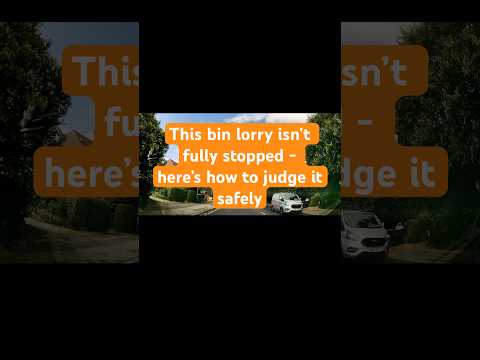
A stationary vehicle is a predictable hazard. A bin lorry — or any vehicle that moves forward in small increments while carrying out a task — is more complex. It may move while you are alongside it, it may pull away sooner than expected, and the operatives on foot around it create additional hazards that must be accounted for before and during the overtake.
The MSM Sequence for This Situation
- Mirrors: check centre mirror and right mirror before any change of position or speed adjustment. A vehicle behind you must be factored into your decision — can you complete the overtake before they arrive?
- Signal: signal right to indicate your intention to move out. This warns following traffic and approaching drivers of your move
- Position: move smoothly to the right to gain a clear view of the road ahead before committing to the overtake
- Speed: you may need to accelerate to complete the overtake in a reasonable time. Do not travel alongside the hazard at the same speed for an extended period
- Return: once past, signal left and return to the left lane smoothly — not sharply cutting in
What to Check Before Committing
Before pulling out to overtake, you must be satisfied on all of these:
- The road ahead is clear for long enough to complete the entire manoeuvre
- No pedestrians or operatives are in the path you will take
- The bin lorry (or hazard vehicle) is not about to move into your path
- Traffic behind you has enough space and is aware of your intention
- There are no junctions, crossings, or hazards on the right side of the road that you would be overtaking into
When Patience Is the Right Answer
If any of the above conditions are not met, the correct decision is to wait. Examiners understand that road situations require patience — they do not expect you to overtake every slow vehicle immediately. What they assess is whether your decision to wait or go is based on genuine safety assessment, not hesitation without reason.
A learner who waits 30 seconds behind a bin lorry because the oncoming traffic is continuous is demonstrating good judgement. A learner who waits and then pulls out without checking mirrors or signalling is demonstrating poor process regardless of whether the road is clear.
This Situation on a Driving Test
If you encounter a slow-moving vehicle on your driving test, the examiner is not testing whether you can overtake quickly. They are testing whether your decision-making process is safe, methodical, and appropriate to the specific conditions. Taking an extra few seconds to be certain is always preferable to an unsafe overtake that results in a serious fault.
What the Highway Code Says About Overtaking (Rules 164–167)
The Highway Code sets out specific rules for overtaking that apply directly to situations like the bin lorry hazard above. Examiners assess your overtaking decisions against this framework.
Rule 164 — Large Vehicles
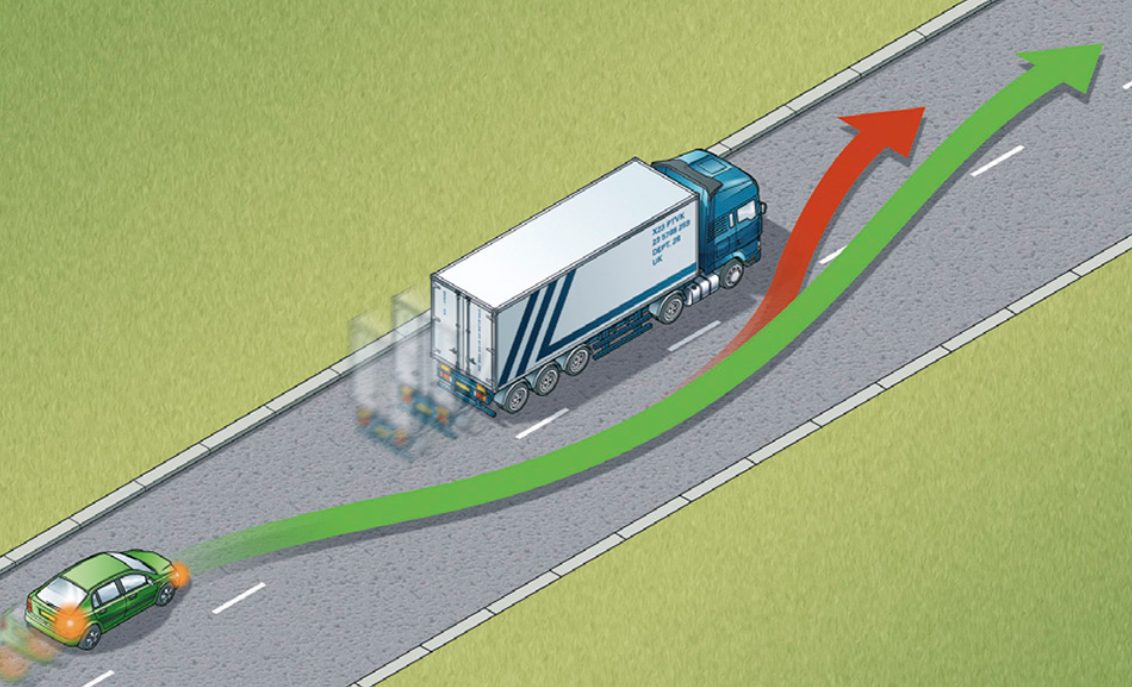
Overtaking large vehicles is more difficult. You should:
- Drop back. This increases your ability to see ahead and should allow the driver of the large vehicle to see you in their mirrors. Getting too close to large vehicles — including agricultural vehicles such as a tractor with a trailer or other fixed equipment — will obscure your view of the road ahead, and there may be another slow-moving vehicle in front.
- Make sure you have enough room to complete your overtaking manoeuvre before committing yourself. It takes longer to pass a large vehicle. If in doubt, do not overtake.
- Not assume you can follow a vehicle ahead which is overtaking a long vehicle. If a problem develops, they may abort overtaking and pull back in.
Rule 165 — You MUST NOT Overtake
- If you would have to cross or straddle double white lines with a solid line nearest to you
- If you would have to enter an area designed to divide traffic, if it is surrounded by a solid white line
- The nearest vehicle to a pedestrian crossing, especially when it has stopped to let pedestrians cross
- If you would have to enter a lane reserved for buses, trams or cycles during its hours of operation
- After a “No Overtaking” sign and until you pass a sign cancelling the restriction
Rule 166 — When You Cannot See Far Enough Ahead
Do not overtake if there is any doubt, or where you cannot see far enough ahead to be sure it is safe. For example, when you are approaching a corner or bend, a hump bridge, or the brow of a hill.
Rule 167 — Where You Might Conflict with Other Road Users
Do not overtake where you might come into conflict with other road users, for example:
- Approaching or at a road junction on either side of the road
- Where the road narrows, or where traffic is queuing at junctions or road works
- When approaching a school crossing patrol, or on the approach to crossing facilities
- Where a vehicle ahead is slowing to stop for a pedestrian crossing from a pedestrian island
- Between the kerb and a bus or tram when it is at a stop
- When you would force another road user to swerve or slow down
- At a level crossing
- When a road user is indicating right — even if you believe the signal should have been cancelled, do not take a risk; wait for the signal to be cancelled
- Stay behind if you are following a cyclist or a horse rider/horse-drawn vehicle approaching a roundabout or junction and you intend to turn left — do not cut across them
- When a tram is standing at a kerbside tram stop and there is no clearly marked passing lane for other traffic
Rules 164–167 quoted from The Highway Code, Using the road (159 to 203), © Crown copyright, licensed under the Open Government Licence v3.0.
Related Guides
Book Lessons on These Roads
H&E trains on the actual Chilwell test routes throughout your course. Book via WhatsApp.