Key Takeaways
- 21 official questions — 14 "tell me", 7 "show me" — grouped into 6 checks below
- One wrong answer is a single driving fault, not an automatic fail
- DVSA hasn't published an electric-vehicle version of this list — see the note below
The Complete Official List — All 21 Questions
All 21 official DVSA questions, grouped into the 6 checks below.
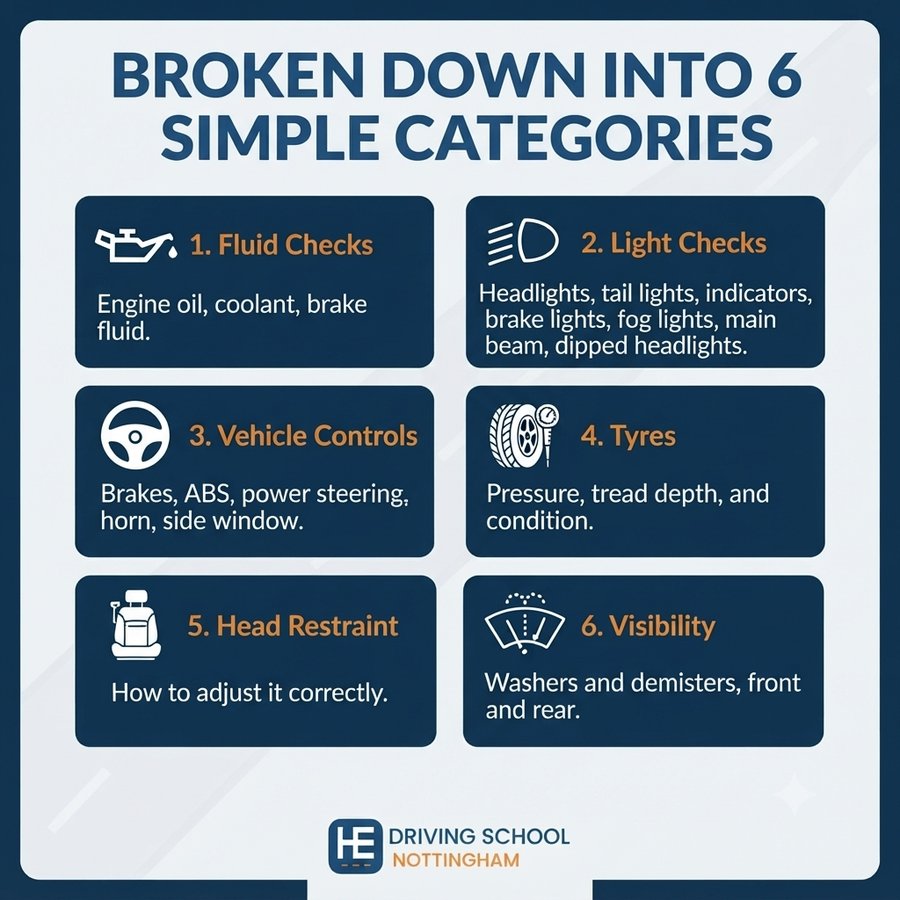
For all three of these, the examiner asks you to open the bonnet first, then explain the check.
"Open the bonnet and tell me how you'd check that the engine has sufficient oil."
Model Answer(Open the bonnet and identify the dipstick.) I'd pull it out, wipe it clean with a cloth, put it back in fully, then pull it out again to check the oil level sits between the MIN and MAX markers.
"Open the bonnet and tell me how you'd check that the engine has sufficient engine coolant."
Model Answer(Open the bonnet and identify the coolant reservoir.) I'd check the level from the side, making sure it sits between the MIN and MAX lines. I wouldn't open the cap while it's hot.
"Open the bonnet and tell me how you'd check that you have a safe level of hydraulic brake fluid."
Model Answer(Open the bonnet and identify the brake fluid reservoir.) I'd check the level sits between the MIN and MAX markers.
"Tell me how you'd check that the headlights and tail lights are working. You don't need to exit the vehicle."
Model AnswerI'd turn on the ignition, switch on the lights, then walk round the car to check each headlight and tail light's working.
"Tell me how you'd check the direction indicators are working. You don't need to exit the vehicle."
Model AnswerI'd turn on the ignition, press the hazard warning light switch, then walk around the vehicle to check all the indicator lights are flashing properly.
"Tell me how you'd check the brake lights are working on this car."
Model AnswerI'd press the brake pedal and check the reflection in windows or doors, or ask someone to check for me.
"Tell me how you'd switch on the rear fog light(s) and explain when you'd use it/them. You don't need to exit the vehicle."
Model AnswerI'd turn on the ignition and dipped headlights, then operate the fog light switch. I'd only use them when visibility drops below about 100 metres, and switch them off again once it clears.
"Tell me how you switch your headlight from dipped to main beam and explain how you'd know the main beam is on."
Model AnswerI'd turn on the ignition, switch on the dipped headlights, then switch to main beam — I'd check the blue warning light comes on the dashboard to confirm it's switched over.
"When it's safe to do so, can you show me how you'd switch on your dipped headlights?"
Model AnswerOperate the correct switch or stalk to turn on dipped headlights — the green headlight icon appears on the dashboard.
"Tell me how you'd check that the brakes are working before starting a journey."
Model AnswerI'd check the brakes as I set off — they shouldn't feel spongy or slack, and the car shouldn't pull to one side.
"Tell me how you'd know if there was a problem with your anti-lock braking system."
Model AnswerI'd check the ABS warning light when the vehicle is started — it comes on briefly, then goes off; it would stay on if there's a fault with the anti-lock braking system.
"Tell me how you'd check the power-assisted steering is working before starting a journey."
Model AnswerThe steering shouldn't feel heavy. I'd check it by giving gentle pressure on the wheel as I start the engine — it should move easily. Alternatively, turning the wheel just after moving off gives an immediate indication the power assistance is working.
"When it's safe to do so, can you show me how you'd operate the horn?"
Model AnswerWhen it's safe, press the horn.
"When it's safe to do so, can you show me how you'd open and close the side window?"
Model AnswerOpen the window using the control, then close it again.
"Tell me how you'd check the tyres to ensure that they have sufficient tread depth and that their general condition is safe to use on the road."
Model AnswerI'd check there are no cuts or bulges on the tyres. The legal minimum tread depth is 1.6mm across the central three-quarters of the tyre, and around its entire outer circumference.
"Tell me where you'd find the information for the recommended tyre pressures for this car and how tyre pressures should be checked."
Model AnswerI'd find the recommended pressures in the manufacturer's guide, often on a sticker inside the driver's door sill, and check them with a reliable gauge when the tyres are cold, including the spare if there is one, then refit the valve caps.
"Tell me how you make sure your head restraint is correctly adjusted so it provides the best protection in the event of a crash."
Model AnswerThe head restraint should be adjusted so the rigid part is at least as high as the eyes or top of the ears, and as close to the back of the head as is comfortable. Some head restraints aren't adjustable.
"When it's safe to do so, can you show me how you wash and clean the front windscreen?"
Model AnswerOperate the washers and wipers for the front windscreen.
"When it's safe to do so, can you show me how you wash and clean the rear windscreen?"
Model AnswerOperate the washer and wiper for the rear windscreen.
"When it's safe to do so, can you show me how you'd demist the front windscreen?"
Model AnswerOperate the controls to demist the front windscreen, using the air conditioning or heater if fitted.
"When it's safe to do so, can you show me how you'd set the rear demister?"
Model AnswerSwitch on the heated rear windscreen.
DVSA has not published an electric-vehicle version of this list — the official GOV.UK page is unchanged since December 2017 and doesn't mention EVs. Since our training car is the fully electric KIA EV4, one question (engine oil) has no direct equivalent, as a battery-electric car has no engine or dipstick. In lessons, we focus on what you can actually check on this car — brake fluid, tyres, lights, washers and demisters — so you're not caught out by whichever questions come up on test day.
Source: DVSA, Car "show me, tell me" vehicle safety questions, GOV.UK.
Preparing for Your Driving Test in Nottingham?
We run through Show Me Tell Me questions on real vehicle checks during lessons, not just as a list to memorise, so you actually understand what you're being asked.
Want to Understand the Checks, Not Just Recite Them?
The answers above are enough to pass — but freezing on test day often comes from memorising wording rather than understanding what each check protects against. Here's the context behind the list, if you want it.
Why Learners Lose Marks Here
A mark lost on a Show Me Tell Me question comes from memorising a script instead of understanding what the check is actually for, which leaves you freezing when the examiner phrases the question slightly differently from how it was rehearsed — not from not knowing the answer.
During your test, the examiner will ask one "tell me" question at the start, before you begin driving, and one "show me" question while you're driving, when it's safe to do so. Getting either one wrong is recorded as a single driving fault — it does not fail the test on its own, unless answering it involves an unsafe action.
Tell Me vs Show Me — What's the Difference?
A "tell me" question asks you to explain how you'd carry out a safety check, for example how you'd know the brakes are working effectively. You answer this before you set off, with the engine off or running as instructed.
A "show me" question asks you to actually demonstrate a control while you're driving, for example operating the windscreen washers or demisting the rear window. Because this happens while driving, the examiner will only ask when it's safe to do so.
Why Memorising Wording Doesn't Work
The question bank covers 21 checks in total, split between the two types. If you've only memorised one exact phrasing of an answer, a question asked slightly differently can throw you — even though you'd have known the answer if you understood the check itself.
It helps more to actually understand what each check is protecting against — for example, why tyre tread depth matters, or why the power steering warning light exists — than to recite a script word for word.
Related Guides
Get Vehicle Checks Right Before Test Day
We cover Show Me Tell Me questions as part of real lessons, so you understand each check instead of just memorising answers.