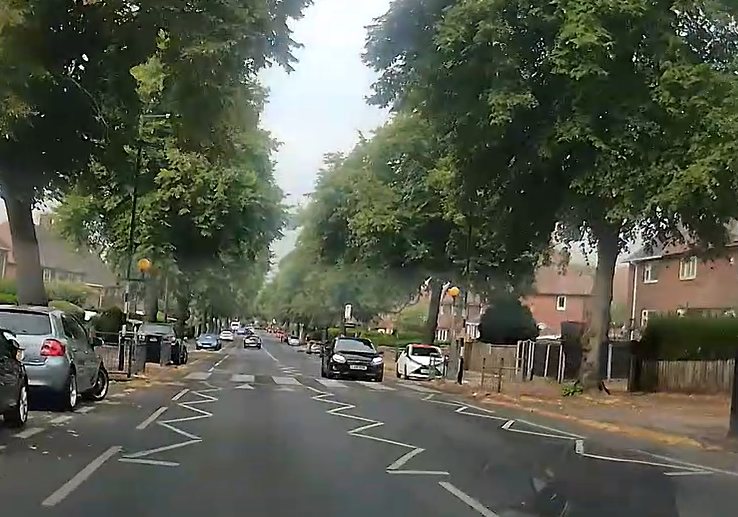
What You Will Learn
- What a zebra crossing requires, and when you must give way
- What each light phase means at a pelican crossing
- Why puffin crossings behave differently to pelican crossings
- What to do at a school crossing patrol
Zebra Crossings
A zebra crossing has no traffic lights — black and white road markings and flashing amber Belisha beacons mark it instead. You should slow down and be prepared to stop for anyone waiting to cross.
“As you approach a zebra crossing look out for pedestrians waiting to cross and be ready to slow down or stop to let them cross. You MUST give way when a pedestrian has moved onto a crossing.” Read Rule 195 on GOV.UK →
In practice: good anticipation means slowing and preparing to give way as soon as a pedestrian shows a clear intention to cross — turning towards the crossing, stepping up to the kerb, making eye contact with you — rather than waiting until they've already committed and stepped onto it. Reading that intent early is what separates a smooth, controlled approach from a last-second stop.
Pelican Crossings
A pelican crossing is light-controlled and operated by pedestrians pressing a button. Unlike an ordinary traffic light, it has a flashing amber phase after the red.
“Pelican crossings are light-controlled crossings... A steady red light means you MUST stop... you MUST give way to pedestrians still on the crossing.” Read Rule 196 on GOV.UK →
During the flashing amber phase you may proceed if the crossing is clear, but you must give way to any pedestrian still on it. This phase catches learners out because it's easy to confuse with a flashing amber at a normal traffic light, which works differently.
Puffin Crossings
A puffin crossing looks similar to a pelican crossing but behaves differently: there's no flashing amber phase. The lights stay red until the crossing is clear, then change straight to green, because on-crossing detector technology tracks whether pedestrians are still crossing.
In practice: treat a puffin crossing's lights like an ordinary traffic light sequence — red means stop, and you wait for green rather than watching for a flashing-amber opportunity to proceed.
School Crossing Patrols
Where a school crossing patrol ("lollipop" person) is on duty, they will step into the road holding a "STOP, CHILDREN CROSSING" sign. You must stop and remain stopped while the sign is displayed, even if no children are visible yet.
Instructor's tip: "The real risk isn't misreading the crossing itself — it's not seeing it coming. Scan for crossing signs and beacons from well back, the same way you'd scan for a hazard, so you're never reacting to a crossing at the last second."
Related Guides
Build Confident Hazard Perception
H&E lessons cover crossings on real Nottingham routes, from zebra crossings in residential streets to pelican crossings in the city centre. Book via WhatsApp.